MERV 8 vs MERV 11 vs MERV 13: Which Should You Buy?
Disclosure: this guide may link to retailers. If you buy through those links, Air Filter Fit may earn a commission at no extra cost to you. It does not change what we recommend. Details.
Short answer: MERV 13 catches far more fine particles than MERV 8. The EPA suggests MERV 13 or as high as your fan and filter slot can handle. If you have a thin 1 inch slot or an older system, check with a technician before jumping straight to 13.
MERV stands for Minimum Efficiency Reporting Value. It comes from an ASHRAE test and reports how well a filter catches particles between 0.3 and 10 microns. Higher numbers catch more, especially the small stuff.
What each rating captures
These are the minimum average capture rates from the EPA's MERV table:
| Rating | 0.3 to 1 micron | 1 to 3 microns | 3 to 10 microns |
|---|---|---|---|
| MERV 8 | not rated | 20% or more | 70% or more |
| MERV 11 | 20% or more | 65% or more | 85% or more |
| MERV 13 | 50% or more | 85% or more | 90% or more |
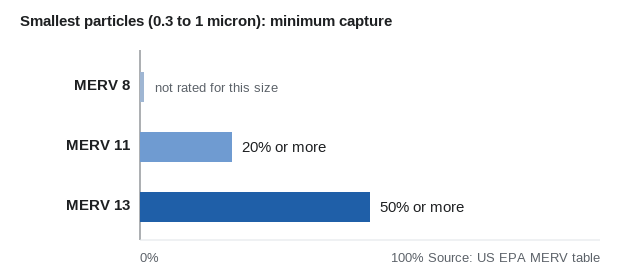
The big difference is in the smallest column. MERV 8 is not rated for particles under 1 micron at all. MERV 13 has to catch at least half of them.
What the EPA recommends
The EPA's guidance is to choose a filter rated at least MERV 13, or as high as your system fan and filter slot can accommodate, and to ask an HVAC technician if you are not sure what your system can take.
A practical way to choose
- MERV 8: fine for keeping dust off the equipment. A reasonable choice for a thin 1 inch slot on an older system.
- MERV 11: a middle step that catches a good share of the 1 to 3 micron range.
- MERV 13: the EPA's suggested target when the system can handle it. Easiest to run in a 4 or 5 inch media cabinet, where there is more filter area.
The worry with higher MERV filters is airflow. That is covered in Is MERV 13 too restrictive for my furnace?
Where to buy
Most sizes come in MERV 8, 11 and 13: compare MERV options at Filterbuy or on Amazon.
Related: 1 inch vs 4 inch filters